Picture by Holger.Ellgaard; License: CC BY-SA 4.0, via Wikimedia Commons.
Picture by VollwertBIT; License: CC BY-SA 2.5, via Wikimedia Commons.
Fehmarn is best known for its beautiful beaches, fresh Baltic Sea air, and relaxed vacation atmosphere. But this sunny island has another side to offer: a surprisingly diverse museum landscape invites you to immerse yourself in the island's history, discover maritime traditions, and get to know the pioneers of water sports. Whether you are looking for an alternative to the beach on a rainy day or are simply interested in the culture and history of Fehmarn, the island's six museums promise exciting insights for the whole family.
From one of Schleswig-Holstein's oldest museums to impressive maritime technology and the state's oldest functioning windmill: every museum on Fehmarn has its own unique character. You will learn how people used to live on the island, what role seafaring played, and how Fehmarn became the cradle of German windsurfing. All museums are easily accessible and offer interesting insights into various topics, even for children.
The Fehmarn Museum awaits you in the heart of Burg, at Breite Straße 49. The building itself is a piece of history. The former preacher's widow's house, dating from 1581, is considered the oldest house on the island. One of the oldest museums in Schleswig-Holstein was founded here in 1897, originally known as the Peter Wiepert Local History Museum and renamed the Fehmarn Museum in 2013.
Spread across 23 exhibition rooms in three historic buildings (the preacher's widow's house, the organist's house, and the Latin school), the museum takes you on a fascinating journey through the history of Fehmarn. You will learn interesting facts about the island's geology, its formation, and the geological features that characterize Fehmarn. The exhibition on regional history shows how life on the island has developed over the centuries.
The sections on seafaring and crafts are particularly impressive. Here you can see model ships, souvenirs brought back by Fehmarn sailors from all over the world, and fishing equipment that tells of the hard life at sea. The exhibitions on guilds, hunting, and folklore provide an authentic impression of traditional island life. Over 6,500 exhibits preserve Fehmarn's local history and cultural heritage for future generations.
A special highlight are the museum tours with Georg Hüttmann, a native of Fehmarn, which take place every Tuesday from 4:00 p.m. With his in-depth knowledge and passion for the island, he will guide you through the history of Fehmarn and bring you closer to the customs, crafts, and shipping industry in a lively way. Registration is not required.
| Opening hours | Tue, Thu, Fri, Sat: 11:00 a.m.–4:00 p.m. |
| Admission fees | Adults: €4.00 (€3.00 with Ostseecard), children under 18: free, schoolchildren/students: €2.50 |
| Address | Breite Straße 49-51, 23769 Fehmarn OT Burg |
| Contact | Tel.: 04371 506 632, E-Mail: museum@stadtfehmarn.de Website: https://www.stadtfehmarn.de/Leben-auf-Fehmarn/Fehmarn-Museum/ |
| Suitable for | History buffs, families, local historians |
The port of Burgstaaken is home to a very special maritime landmark: the U11 submarine, a decommissioned NATO submarine of the 205mod class, which served in the German Navy from 1968 to 2003. The 560-ton, 43.5-meter-long submarine was brought to its current berth in 2005 using two cranes and has since become a popular destination for technology enthusiasts and families.
During a tour of the submarine, you will gain authentic insights into the life of the crew in confined spaces and the many technical features of the submarine. The adjacent exhibition provides information about the German post-war submarine fleet and the history of this special vessel.
You can find all the details about the tour, the history of the submarine, and practical information in our detailed article: Fehmarn Submarine Museum.
Right at the harbor in Burgstaaken, just a few meters from the submarine, another maritime highlight awaits you: the Maritime Rescue Museum. The main attraction is the legendary sea rescue cruiser “Arwed Emminghaus”, named after a German journalist and economist who campaigned for the establishment of an organized sea rescue service.
The 26.66-meter-long cruiser has had an eventful history. From May 1965 to October 1985, it was in service in Cuxhaven before finding its new home in Grömitz and securing the Bay of Lübeck south of Fehmarn. After almost 30 years of service for the German Maritime Search and Rescue Service (DGzRS), the ship was decommissioned in 1993. But the Arwed Emminghaus was far from ready for retirement: under the name “Hannes P. Hafstein 2188,” it was stationed in Iceland until the end of 2006 before being purchased by three museum enthusiasts from Fehmarn in 2013.
The Maritime Rescue Museum opened in October 2014. You can explore the entire ship and get an authentic impression of the life and work of maritime rescuers. On board, there are numerous photos and film documents that vividly illustrate the work of that time. The exhibition “Adventure Sea Rescue” ties in with the Arwed Emminghaus and displays information and exhibits from 150 years of sea rescue.
A special feature of the museum is its interactive design: behind numerous cabinet doors are hidden many rarities relating to Arwed Emminghaus, traditional rescue technology, and sea rescue on Fehmarn. A cinema visually recounts the history of the rescue cruiser, and a children's corner provides playful entertainment for the youngest visitors. You can also visit the daughter boat “Alte Liebe.”
| Opening hours | Daily from 11:00 a.m. to 4:00 p.m. |
| Admission fees | Adults: approx. €6–7, children (aged 4–14): €4, family tickets available |
| Address | Burgstaaken 89, 23769 Fehmarn OT Burgstaaken |
| Contact | Tel.: 04371 87 97 777, info@seenotrettungsmuseum-fehmarn.de |
| Suitable for | Families, maritime enthusiasts, history buffs |
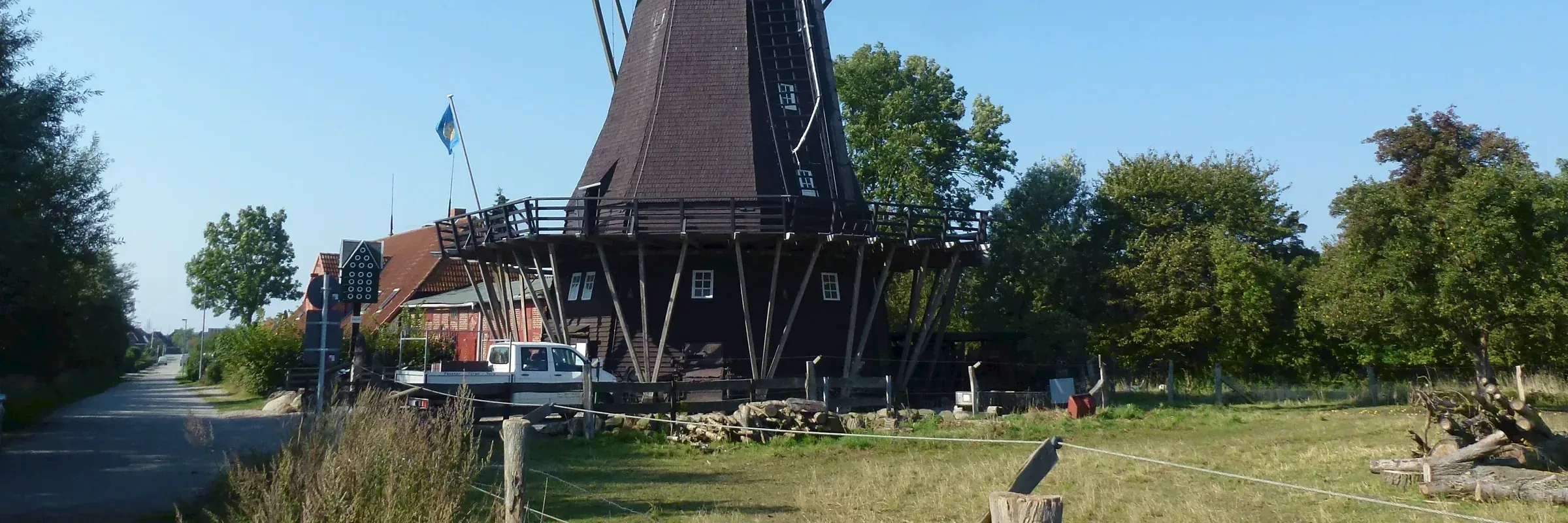
A special technical monument stands in the tranquil Lemkenhafen: the “Jachen Flünk” windmill (named after its first owner, Joachim Rahlff) was built in 1787 by a grain merchant and shipowner and is now one of the oldest fully preserved, still functioning windmills in Schleswig-Holstein, equipped with three grinding gears and wind sails. Even from a distance, you can see the four mighty sails silhouetted against the sky.
The “Jachen Flünk” is a gallery Dutch mill with a shingled hull. This is a particularly robust construction, which has ensured the mill's survival. In the past, barley and wheat were ground here into high-quality pearl barley, which was exported to the Nordic countries. The quality was so good that the millers on Fehmarn often earned one to two pfennigs more per pound than other millers. The different sail positions made it possible to run the mill continuously under load with up to four grinding gears at times.
After World War I, times became more difficult for windmillers, and in 1954, operations had to be discontinued. The mill was scheduled for demolition, but shortly before demolition, local history enthusiasts from Fehmarn managed to save it. In 1958, the state of Schleswig-Holstein took over the mill, extensively renovated it, and restored the machinery to working order. Since June 16, 1961, the mill has been open to the public as a mill and agricultural museum and is a listed building.
On the various floors of the mill, you can view the historic machinery and learn all about the history of windmillry on Fehmarn and the millers who worked here. An agricultural museum section has been set up in the adjacent warehouse, displaying tools, household items, and models of Fehmarn farms that were once used in Fehmarn's agriculture. A fully equipped historical smithy gives an impression of traditional crafts on the island.
| Opening hours | May to mid-October: daily except Wednesdays, 10:00 a.m. to 5:00 p.m. |
| Admission fees | Adults: €5.50 (€5.00 with Ostseecard), children up to 14 years: free, schoolchildren/students: €2.50 |
| Address | Mühlenweg 45, 23769 Fehmarn OT Lemkenhafen |
| Contact | Tel.: 04372 18 94 Webseite: https://www.museum-fehmarn.de/muehlenmuseum.html |
| Special features | Parking lot approx. 300 m away, short walk to the mill |
| Suitable for | Families, technology enthusiasts, history buffs |
At the port of Burgstaaken, not far from the submarine and maritime rescue museum, the Übersee Museum opens a window to the world. Under the motto “Art, Culture, Peoples' Forum,” this museum displays traditional handicrafts and everyday objects from different peoples across all continents. The exhibition is part of the Galileo Knowledge World, but is located at its own site.
The museum presents over 1,000 exhibits from Africa, Asia, America, Australia, and Oceania. You will see artistic carvings, traditional textiles, masks, weapons, jewelry, and everyday objects that tell of the lives and cultures of different peoples. The differences and similarities between human habits and ways of life are highlighted. It is a fascinating insight into the diversity of cultures on our planet.
The museum's goal is to promote international understanding and raise visitors' awareness of other cultures. The exhibition is designed so that children can learn in a playful way how differently and yet similarly people live on different continents. Multimedia presentations and historical photo documentaries complement the exhibits and transport you to foreign worlds and long-lost cultures.
| Opening hours | April–November: daily from 11:00 a.m. to 4:00 p.m., winter months: by appointment only |
| Admission fees | Adults: approx. €14.50, children: €13, combination tickets with other Galileo museums available |
| Address | Burgstaaken, Hafen, 23769 Fehmarn |
| Suitable for | Culture enthusiasts, families with children, ethnology fans |
The legendary Charchulla twins Jürgen and Manfred made Fehmarn the cradle of German windsurfing. Born in 1939, the two brothers are considered pioneers of windsurfing and have had a significant influence on the surfing scene since the 1970s. Since 1972, they have been passionately collecting exhibits from the history of board sports. They have already amassed over 1,500 pieces suitable for exhibition.
The Surf Twins made history: on May 25, 1975, they became the first surfers to cross the English Channel, one of Europe's busiest waterways, on a tandem surfboard. In 1977, they followed up this achievement by crossing the Skagerrak from Denmark to Norway in 14 hours. In 2010, they went one better with six other surfers: using the “Fehmarn-Achter,” the longest windsurfing board in the world, they crossed the Fehmarn Belt in just 59 minutes, setting a world record.
Back in 2007, the Charchulla twins opened Europe's first surfing museum in Burg on Fehmarn, which attracted up to 30,000 visitors a year. Unfortunately, it had to close in 2011 because the premises were no longer available. Since then, the Verein Surfmuseum Fehmarn International e.V. association has been working on a new, permanent location. The impressive collection includes the legendary world record windsurfing tandem “Der Fehmarn-Achter,” early wing rigs from 1980 (precursors to today's wings), the first surfboards that came to Germany in the 1970s, and numerous other historic boards and rigs from five decades of surfing history.
Until a new museum opens, the Charchulla twins occasionally display their collection at temporary exhibitions and surf festivals. The two charismatic surfing pioneers are still active today: they run their surfing schools on South Beach in Burgtiefe and at the Strukkamphuk campsite, and occasionally give talks about their surfing adventures. If you're interested in the history of windsurfing, it's worth checking the website or Facebook page for current exhibition dates.
| Status | New permanent location in planning, temporary exhibitions possible |
| Collection | Over 1,500 exhibits from 50 years of surfing history |
| Contact | Wassersport Charchulla, Surfschule Burgtiefe am Südstrand |
| Information | www.surfmuseum-fehmarn.com, wassersport-charchulla.de |
| Who might be interested | Water sports enthusiasts, surfing enthusiasts, history buffs |
The museums on Fehmarn can easily be integrated into your vacation. Especially on days with changeable weather or in the off-season, they are a welcome change from the beach. Here are some practical tips for your museum visit:
If you want to visit several museums, it is worth asking about combination tickets. The Übersee Museum, for example, offers discounted combination tickets together with the other Galileo Wissenswelt locations. With the Ostseecard, you can get discounts at the Fehmarn Museum and the Lemkenhafen Mill Museum. Most museums are easily accessible by bike or car. There is plenty of parking in Burg and Burgstaaken, and the parking lot at the Lemkenhafen Mill Museum is about 300 meters away. However, the short walk through nature is quite charming.
Plan to spend about one to two hours at each museum, depending on how much time you want to spend looking at the exhibits. The Fehmarn Museum and the Mill Museum offer guided tours that give you particularly in-depth insights. All museums are family-friendly and designed to be interesting for children. Young visitors are particularly enthusiastic about the Maritime Rescue Museum with its walk-in ship and the Submarine Museum.
The six museums on Fehmarn show that the island has much more to offer than just beaches and the sea. From the multifaceted local history in the Fehmarn Museum to impressive maritime technology, the oldest functioning windmill in Schleswig-Holstein, and the eventful history of windsurfing, each museum has its own unique character and invites visitors to make exciting discoveries.
Whether you are interested in history, technology, ethnology, or water sports, Fehmarn's museums offer something for everyone. And the best part is that even in rainy weather, you don't have to miss out on interesting vacation experiences. The museums are the perfect complement to your beach vacation and allow you to get to know Fehmarn from a completely different perspective.
You have booked a Vacation accommodation on Fehmarn and looking for more Sights on Fehmarn or would like to Rent sports equipment or beach chairs? Follow the links for more information.