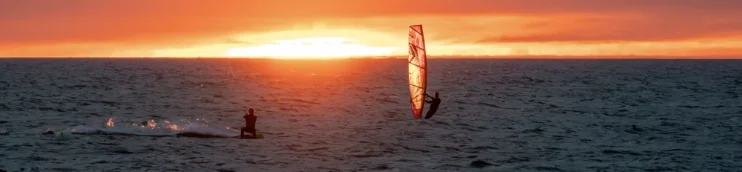
Picture by Chris Mayer; hier sein Instagram
For windsurfers, Fehmarn is much more than just an island in the Baltic Sea. It is the birthplace of German surfing and remains one of the best windsurfing spots in Germany. Its geographical location far out in the Baltic Sea ensures exceptionally reliable winds. While the mainland coast is often calm, you can find a suitable spot on Fehmarn for almost any wind direction. The extensive shallow water areas are particularly valuable, providing safety for beginners and perfect conditions for advanced surfers to practice new maneuvers.
In this detailed guide, you will learn everything about the history of windsurfing on Fehmarn, the best spots for every wind direction and skill level, what equipment you need, and where to find the ideal accommodation for your surfing vacation.
Fehmarn rightly bears the name “Hawaii of the North.” The island juts far out into the Baltic Sea and is surrounded by water on all sides. This exposed location ensures constant wind, even when there is no wind on the mainland. The Baltic Sea generates local thermal winds, and the relatively flat coastal landscape allows the wind to sweep unchecked across the island.
One of Fehmarn's key advantages is its numerous standing areas. In Burger Binnensee, in Gold, or at Grüner Brink, you can stand in waist- to chest-deep water for hundreds of meters in some places. This not only gives beginners confidence when learning to water start, but also allows advanced riders to effectively practice new maneuvers without constantly worrying about deep water. The shallow waters also warm up faster than deeper areas in summer, allowing for longer sessions in the water.
The surfing season on Fehmarn is pleasantly long. The first surfers are out on the water as early as Easter, when the first warm days arrive. The main season runs from May to September, but there are still many good windy days in October. Die-hard surfers even surf in winter, although a thick wetsuit is essential then.
The water temperature of the Baltic Sea around Fehmarn varies greatly with the seasons. In spring (April/May), it is around 8 to 12 degrees Celsius. Here you will need a 5/4 mm or even 6/5 mm wetsuit with a hood, gloves, and booties. In midsummer (July/August), the water warms up to a pleasant 18 to 22 degrees. Then a 3/2 mm wetsuit is often sufficient, or even a shorty when the sun is shining.
In autumn (September/October), temperatures drop again to 12 to 16 degrees, so a 4/3 mm suit is recommended. In winter, temperatures drop to 2 to 6 degrees. Only with a high-quality 6/5 mm wetsuit, hood, gloves, and boots should you venture out onto the water.
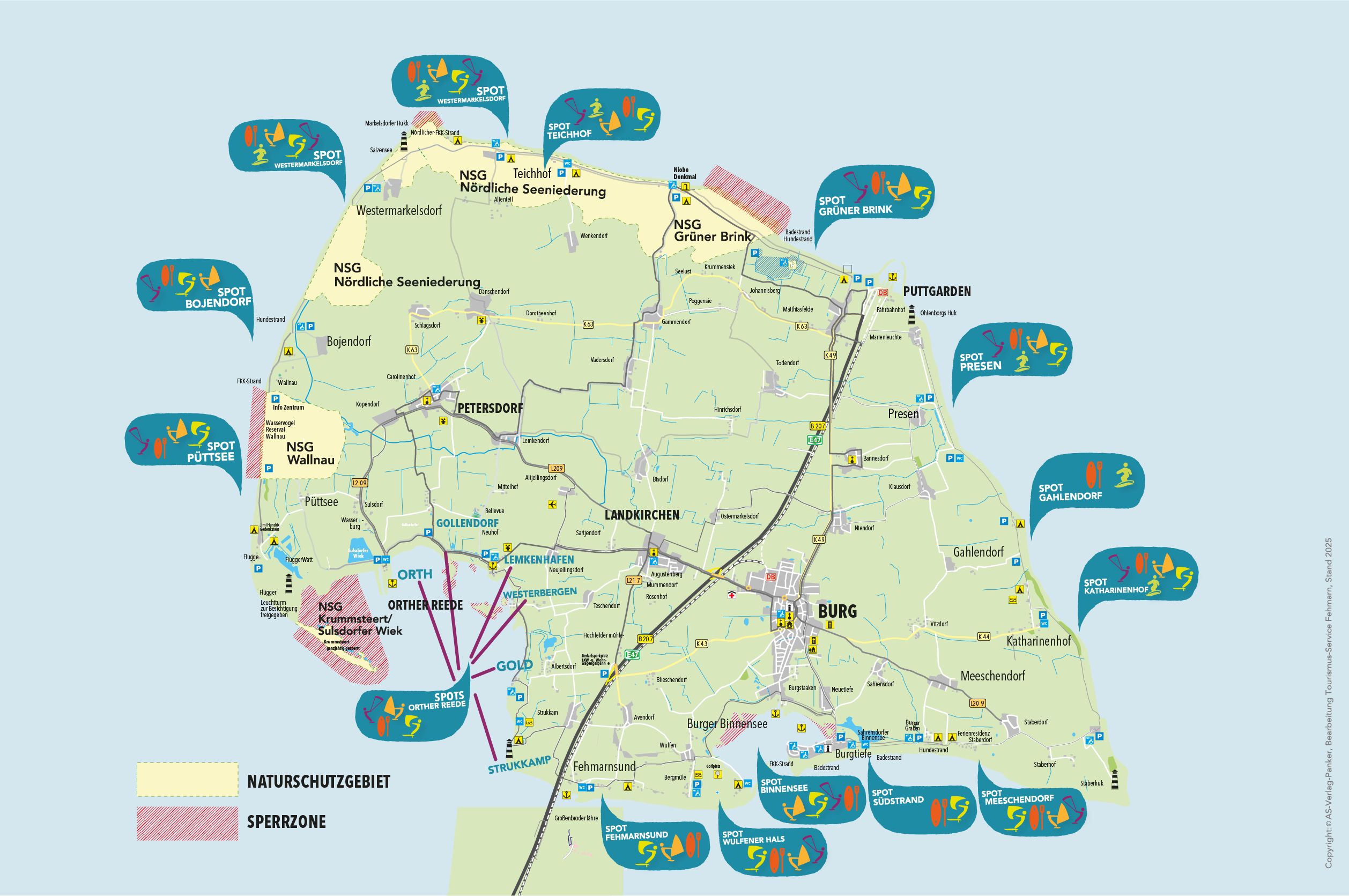
Fehmarn offers the right spot for every wind direction and every skill level. In total, there are around 18 Surfspots. The island has the great advantage that you can find optimal conditions somewhere for almost any wind direction. Here are the most important spots in detail.
The Gold spot is located on the west coast of Fehmarn, roughly halfway between Burg and Lemkenhafen. It is known among windsurfers and kitesurfers worldwide and is considered one of the best standing areas in Europe. What makes Gold special is the huge flat water zone that extends far out to sea when the wind is blowing from the west. Here, you can stand in waist- to chest-deep water for long distances, which is perfect for practicing maneuvers.
The spot works best with winds from the southwest, west, and northwest. With these wind directions, the water is relatively smooth and conditions are ideal. On good days, however, it can get very crowded here, as surfers from all over Germany and even abroad flock to Gold for their vacations or days off. If you want to avoid the crowds, come early in the morning or later in the afternoon. It is also much less crowded in the off-season.
Parking spaces are available directly on the beach. There is a small infrastructure with toilets. A beach fee is payable during the high season. Please note that the beach is officially divided into zones. Windsurfers and kitesurfers should use the designated areas to avoid conflicts with bathers.
Grüner Brink is located in the northeast of Fehmarn and is part of a nature reserve. This spot works great with winds from the northeast, north, and northwest. Here, too, you have a large standing area that gives you safety. The landscape is beautiful and unspoiled. You surf directly in front of the backdrop of the protected coastal strip.
Important: Water sports are only permitted in designated areas at Grüner Brink. The nature reserve is home to numerous bird species that breed and rest here. Be sure to follow the markings and respect the protected areas. You can find out more about the fascinating Grüner Brink nature reserve in our article about the Nature reserves on Fehmarn.
Parking is available at Grüner Brink beach. From there, it's just a few minutes' walk to the water. This spot is less crowded than Gold and offers a great alternative for quieter surfing, especially in the off-season.
Burger Binnensee is located in the southeast of Fehmarn, right next to Burgtiefe and the south beach. This spot is particularly convenient for guests staying at Inselblume accommodations. You can walk to the water in just a few minutes from the south beach or Burgtiefe. The inland lake is connected to the Baltic Sea by a narrow passage, which keeps the water relatively calm.
The water is very shallow and the waves are minimal. This makes Burger Binnensee the ideal practice spot for beginners and intermediate surfers. Surf schools make extensive use of the water for their courses. Stand-up paddlers and children who want to gain their first experience on a board also feel at home here. The spot works best when the wind is coming from the east, southeast, south, and southwest.
The infrastructure on South Beach is excellent. There are restaurants, snack bars, toilets, and showers. There is plenty of parking available. The Charchulla water sports school is located directly on South Beach and offers courses and equipment rental.
On the south coast between Burgtiefe and Staberhuk, there are other interesting spots such as Wulfen and Katharinenhof. These work well with a south wind and also offer standing areas. The spots are not quite as well known as Gold or Grüner Brink, but that's precisely why they often offer more space on the water. When there is an onshore south wind, small waves can form here, which are interesting for advanced surfers.
Altenteil and Westermarkelsdorf in the north of the island are spots for experienced surfers. When there are strong winds from the north to northwest, considerable waves can build up here. Conditions can be significantly rougher than at the shallow water spots in the south and west. Currents can be strong, and the water quickly becomes deep. This spot requires technical skill and experience in surfing.
| Spot | Best wind direction | Level | Special features |
| Gold | SW, W, NW | All levels | Large standing area, very well known |
| Green Brink | NE, N, NW | Beginner to advanced | Nature reserve, observe zones |
| Burger inland lake | E, SE, S, SW | Beginner | Very flat, ideal for learning |
| Wulfen/Katharinenhof | S, SE, SW | Beginner to advanced | Less crowded |
| Altenteil/Westermarkelsdorf | NW, N, NE | Advanced to professional | Waves, currents, challenging |
Windsurfing is a relatively safe sport if you follow a few basic rules. Assess your abilities realistically and only surf in conditions that you can handle. If the wind is too strong or the water too rough, stay on land. Never underestimate the power of nature.
Always wear a life jacket or buoyancy aid, especially if you are not very experienced. An impact protection vest provides additional protection against injuries in the event of falls or collisions with your own equipment. Before surfing, find out about the local conditions: Are there any currents? Where are the shoals or rocks? Where is surfing permitted?
Keep a safe distance from other surfers, swimmers, and boats. Right of way rules apply on the water: anyone sailing on the starboard bow (wind from the right) has right of way. Always be aware of your surroundings and avoid collisions. If you get into trouble, use the internationally recognized distress signal: raise both arms vertically above your head and wave.
Never surf alone in remote spots. If something happens, it is important that someone can get help. Check your equipment for damage before each session. Tears in the sail, defective lines, or loose screws can lead to dangerous situations.
Windsurfing looks easier than it is. The first few hours on the board are often frustrating. You fall into the water, the sail is blown away by the wind, and you just can't seem to get started. But don't worry, that's completely normal. With the right instruction and a little patience, you'll quickly get the hang of it.
A professional course at one of the surf schools on Fehmarn is highly recommended for beginners. There, you will first learn the basics on land: How does the wind work? How do I hold the sail correctly? How do I stand on the board? Then you will head into shallow water, where you will cover your first few meters on the board. The surf instructors will correct your posture and help you if the sail becomes too heavy.
After a basic course lasting around three to five days, most beginners are already able to surf their first independent routes. The water start, i.e. getting up on the board directly from the water, usually takes a little longer. It often takes several weeks of practice before you can safely sail in different directions and jibe. But every minute on the water is worth it.
Fehmarn has an exceptionally high density of surf schools and rental stations. This is due to the island's long tradition as a surfing hotspot. The best-known surf school is undoubtedly the Charchulla water sports school in Burgtiefe on the south beach, run directly by surfing pioneers Jürgen and Manfred Charchulla. Here you can not only book courses, but also rent high-quality equipment.
You can find other established surf schools in Gold, Lemkenhafen, and at the Strukkamphuk campground. The schools offer beginner courses, advanced courses, and specialized courses for maneuvers such as power jibes and water starts. For prices and current course offerings, it is best to contact the providers directly.
If you already know how to surf and just need equipment, there are numerous rental companies available. You can rent boards in various sizes and sails in different square meter sizes. The rental companies will advise you on which equipment suits your skill level and the current wind conditions. For prices and availability, contact the rental companies directly.
We have compiled a detailed overview of all surf schools and rental companies on Fehmarn for you: Overview of all water sports equipment rental companies on Fehmarn
In addition to windsurfing, Fehmarn has also established itself as a top destination for other board sports. Kitesurfing is now almost as popular as windsurfing. In kitesurfing, you are pulled across the water by a stunt kite. The dynamics allow for spectacular jumps and tricks. The standing areas in Gold and at Burger Binnensee are also ideal for kitesurfers.
Wingfoiling is the latest trend on Fehmarn. You hold an inflatable wing in your hand and stand on a board with a foil, an underwater wing. Once you reach enough speed, the board lifts out of the water and you glide almost silently over the surface. Wingfoiling requires less wind than windsurfing and is slightly easier to learn than kitesurfing.
Stand-up paddleboarding (SUP) is the perfect alternative for windless days. With a large, stable board and a paddle, you can move leisurely across the water. SUP is an excellent full-body workout and very relaxing at the same time. Burger Binnensee is an ideal location for SUP tours.
Every year on Ascension Day (end of May), the south beach in Burgtiefe is transformed into a huge festival site. The Fehmarn Surf Festival is Germany's largest windsurfing event and attracts thousands of visitors. All the major surf brands are represented with stands, and you can test the latest equipment free of charge. Everything is available, from beginner boards to high-tech slalom boards.
Competitions are held on the water, where professionals and amateurs show off their skills. Freestyle battles, slalom races, and fun contests provide entertainment. There are also competitions for kitesurfers and wingfoilers. In the evening, the beach transforms into a party zone. Live bands play on stage, DJs spin records, and the beach is a party zone until late into the night.
Das Surffestival ist der ideale Zeitpunkt für einen Besuch auf Fehmarn, wenn du die Surfkultur hautnah erleben möchtest. Du triffst Gleichgesinnte aus ganz Europa, knüpfst Kontakte und kannst dich über die neuesten Trends im Wassersport informieren. Der Eintritt zum Festival ist frei.
When talking about windsurfing on Fehmarn, two names inevitably come up: Jürgen and Manfred Charchulla. Born in 1939, these identical twins made Fehmarn the cradle of German windsurfing and have had a decisive influence on the surfing scene since the 1970s. Their water sports school in Burgtiefe on the south beach is one of the oldest and most renowned surfing schools in Germany.
The Surf Twins have achieved impressive milestones. On May 25, 1975, they became the first surfers in the world to cross the English Channel, one of Europe's busiest waterways, on a windsurfing tandem. In 1977, they followed up this achievement by crossing the Skagerrak from Denmark to Norway in 14 hours. But their most spectacular record came in 2010: together with six other surfers, they crossed the Fehmarn Belt on the “Fehmarn-Achter,” the world's longest windsurfing board, in just 59 minutes. This world record still stands today.
Since 1972, the Charchulla twins have been passionately collecting exhibits from the history of board sports. Their collection comprises over 1,500 exhibits, including the legendary world record tandem and the first surfboards that came to Germany in the 1970s. You can find out more about this fascinating collection in our article about the Museums on Fehmarnwhere we also discuss the planned surf museum.
The two charismatic surfing pioneers are still active today: they run their surfing schools on the south beach in Burgtiefe and at the Strukkamphuk campsite, passing on their knowledge to new generations. Their expertise and passion have contributed to Fehmarn now being considered Germany's surfing mecca.
As a windsurfer, you have special requirements when it comes to accommodation. A cramped hotel room is usually impractical. You need space for your board, sail, and rig. It's also important to have somewhere to dry your wetsuit. A vacation house, bungalow, or spacious vacation home is therefore a better choice.
Our bungalows in the Arne Jacobsen settlement on South Beach are particularly suitable. They offer plenty of space and often have a garden or terrace where you can set up and dry your equipment. The location right on South Beach is ideal: Burger Binnensee is within walking distance and other spots on the island are also not far away.
Many of our accommodations are also dog-friendly. If you want to take your four-legged friend with you on your surfing vacation, we have the perfect solution for you. Your dog will love long walks on the beach while you're out on the water.
Take a look at our spacious bungalows here: View bungalows on Fehmarn
We also have suitable offers for surfers with dogs: Vacation homes with dogs on Fehmarn
If you are planning your first surfing vacation on Fehmarn, you may be wondering what you should pack. In addition to the usual vacation gear, there are a few special items that are important for surfers.
Be sure to bring:
Helpful, but not mandatory:
If this is your first time vacationing in a vacation home, we have created a detailed general packing list. You can download and print it free of charge: Packing list for vacation home holidays
Fehmarn offers windsurfers unique conditions in Germany. The combination of reliable wind, diverse spots for every skill level, and legendary standing areas makes the island a surfing mecca. The history of German windsurfing is closely intertwined with Fehmarn and the Charchulla twins. This tradition lives on today and shapes the island's surfing culture.
Whether you're taking your first steps on the board or already mastering jibes and power jibes, you'll find the right conditions on Fehmarn. Professional surf schools help beginners get started, and experienced local heroes are happy to give tips on the best spots and conditions.
The spacious accommodations at Inselblume Fehmarn offer you the ideal base for your surfing vacation. After a long day on the water, you can relax in your bungalow or vacation home, take care of your equipment, and look forward to the next session.
Book your accommodation now and experience for yourself why Fehmarn is considered the Hawaii of the North: Discover accommodations in prime locations
Do you have any questions about windsurfing on Fehmarn? Feel free to contact us via Telephone or Mailif you need further information or are looking for tips for your surfing vacation on this sunny island.