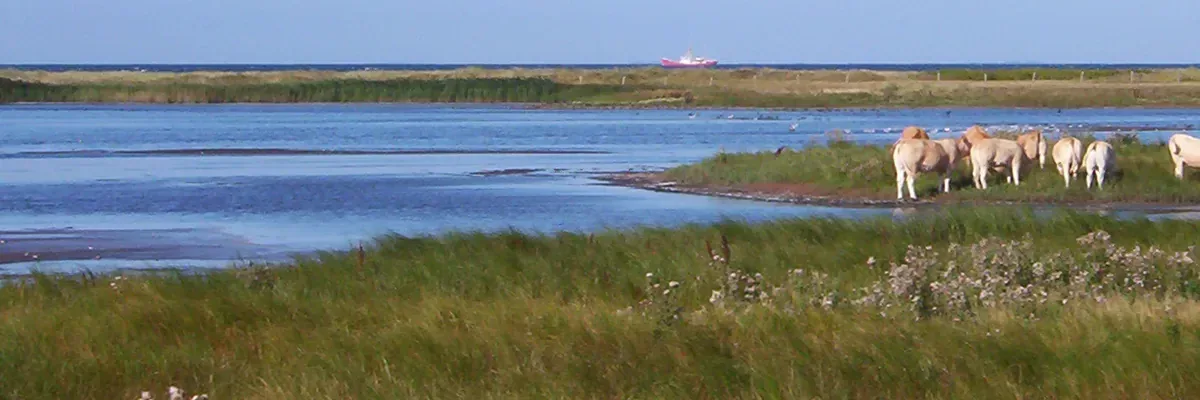
Cover picture provided by Francis Bee; License: CC BY-SA 3.0, via Wikimedia Commons.
Fehmarn is not only the sunny island of the Baltic Sea, but also a true natural paradise. Four designated nature reserves offer countless animal and plant species a protected habitat and give you the opportunity to experience the island's unspoiled nature up close. Particularly impressive: the island lies on the so-called bird migration route between Central Europe and Scandinavia. Every year, hundreds of thousands of migratory birds stop here on their way to their breeding or wintering grounds.
Whether you are an avid birdwatcher, enjoy hiking in nature, or simply want to enjoy the peace and quiet of the coastal landscape, the nature reserves on Fehmarn are worth a visit at any time of year. From the extensive ponds in Wallnau to the impressive beach ridge landscape at Grüner Brink and the dynamic Krummsteert spit, each nature reserve has its own unique character and special features.
The NABU Wallnau Waterbird Reserve on the west coast of Fehmarn is the largest and best-known nature reserve on the island, covering almost 300 hectares. This is where the migration routes of water birds and land birds intersect, attracting up to 250 different bird species to the area every year. A true paradise for birdwatchers and nature lovers.
The history of Wallnau is remarkable: around 400 years ago, this area was still a bay of the Baltic Sea. Sediment deposits formed a spit that separated the bay from the open Baltic Sea. At the end of the 19th century, the resulting wetland was artificially drained and used for agriculture. As the soil proved unsuitable, NABU purchased the area in 1975 together with the district of Ostholstein and the Frankfurt Zoological Society. Since then, Wallnau has been professionally managed as a nature reserve and has developed into one of the most ecologically valuable regions in northern Germany.
Today, a diverse mosaic of ponds, reed beds, wet meadows, and small copses characterizes the landscape. At its heart is a sophisticated canal system that precisely regulates the amount of water in the area, creating optimal living conditions for breeding and migratory birds. Gray geese, avocets, reed warblers, spoonbills, and many other species thrive in the dense reeds, on the extensive wet meadows, and along the muddy shores.
From March to October, the visitor center with its modern information center offers comprehensive information about the importance of nature conservation. The nature trail guides you through the area with exciting play stations and informative themed columns. For children, there is a small touch and smell trail where they can test their senses. From the ten-meter-high observation tower, you have a magnificent view over the entire nature reserve and can observe the birds from a bird's eye view.
A particularly clever feature is the observation hides integrated into the privacy screen that separates the core area of the reserve from visitors. From these hides, you can observe the shy animals at close range without disturbing them. NABU also offers regular guided tours, during which experienced conservationists explain the interrelationships and teach you about the need to protect nature.
You can find more information about opening hours and offers in our detailed article about the Wallnau Waterfowl Reserve.
Grüner Brink on the north coast of Fehmarn is one of Schleswig-Holstein's oldest nature reserves. The approximately 134-hectare area has been under protection since 1938. It stretches 2.5 kilometers along the coast between Puttgarden and Gammendorf and extends from the top of the dike up to 150 meters into the Baltic Sea.
This unique landscape was created by the construction of dykes after the devastating flood disaster of 1872. The changed current conditions caused sand and debris to accumulate, creating spits. These grew landward and successively blocked three beach lakes of different ages from the open Baltic Sea. A characteristic coastal heath has developed on the older beach ridges further away from the coast. This is a rare and protected form of vegetation in Germany.
Grüner Brink is centrally located on the water bird migration route, making it a hotspot for birdwatchers. Thanks to this migration route, you can observe almost half of all European bird species here. Up to 170 species are counted each year. The characteristic bird of the area is the red-necked grebe, which breeds in large numbers on the reed-lined beach lakes. Geese, ducks, mergansers, waders, terns, and gulls also make use of the varied structures of this landscape.
An absolute highlight is the migration of birds of prey from late August to early September. Coming from the north, buzzards, sparrowhawks, ospreys, and even owls fly over the nature reserve. It is very impressive to see these majestic birds circling in the sky, taking advantage of the thermal currents above the coast.
The area is accessible via several well-maintained footpaths, allowing you to observe the birds at your leisure. The best place to park is at Grüner Brink beach, from where you can walk along the beach over the dike to the striking Niobe Monument, which commemorates the sinking of the SMS Niobe training ship in 1932. NABU takes care of the nature reserve and also offers guided tours of the Brink.
Incidentally, Grüne Brink is not only interesting for birdwatchers. Kitesurfers and windsurfers also appreciate the nearby coastal areas for their good wind conditions. If you want to get out on the water yourself, you will find perfect conditions further south on the south beach for Kitesurfing and windsurfing.
The 395-hectare Krummsteert-Sulsdorfer Wiek nature reserve is located at the southwestern tip of Fehmarn. The name “Krummsteert” comes from Low German and means “crooked tail.” This is an apt description for the characteristic spit that extends into the sea here. The area was redesignated in 1980 and bears the nature reserve number 90.
The spit hook is one of the natural features in Germany that is protected due to its dynamic nature. This means that the natural processes of sedimentation and erosion caused by wind, waves, and currents are allowed to continue undisturbed here. Therefore, the Krummsteert may not be entered. However, you can observe and photograph it perfectly well from the shore.
The nature reserve encompasses various ecosystems and biotopes: the dynamic spit itself, the Sulsdorfer Wiek (a protected bay), reed beds, and ponds. This diversity makes the area particularly valuable for birdlife. Typical coastal plants such as sea kale, glasswort, and sea mustard characterize the vegetation, while various wading birds, ducks, and gulls find food and resting places here.
The footpath from Orth to Flügge lighthouse leads directly past Sulsdorfer Wiek. On this picturesque trail, you will also cross the reed bed known as “Rammskamp” and pass the Flügger ponds, which are designated as a landscape conservation area. Since 2005, newly designed information boards have provided details about the birds that breed and migrate here. The hike to the lighthouse, which you can also visit and climb, is a real experience, especially during the migratory bird season in spring and fall.
Since its designation, the area has been managed by NABU Schleswig-Holstein. During the summer months, a NABU nature conservation officer is on site to carry out regular ornithological and botanical surveys.
The approximately 751-hectare Fehmarn Northern Lake Lowlands Nature Reserve is the youngest of the four protected areas. It has only been under protection since August 29, 2014, and is the 15th nature reserve in the district of Ostholstein. Despite its young status, it is of enormous importance for nature conservation, as it is largely part of the FFH areas “Coastal Strip West and North Fehmarn” and “Marine Area of the Eastern Kiel Bay” as well as the EU bird sanctuary “Eastern Kiel Bay.”
The area stretches along the northern coast of Fehmarn, extending from the Grüner Brink car park via Wenkendorf and Altenteil to Fastensee lake south of Westermarkelsdorf. It consists of three sub-areas and protects both the lagoons and lakes behind the dike and the surrounding areas. In the northwestern area at Markelsdorfer Huk, it also protects the lagoons in front of the dike and the adjacent shallow water area of the Baltic Sea.
The landscape is characterized by a compensatory coast typical of the Baltic Sea coast, with beach ridges and enclosed lagoons and inland lakes. Behind the dike, large inland lakes have formed, surrounded by extensive reed beds, salt marshes, flat coastal fens, and grasslands. In the northwest and west, you will find dune areas, gravel beaches, and wash margins where, among other things, the characteristic sea kale grows. The white dunes are colonized by beach grass, and herbaceous vegetation grows on the dune areas inland.
The nature reserve is home to an impressive variety of endangered species. Marsh harriers, bitterns, red-breasted mergansers, garganeys, red-crested pochards, avocets, redshanks, snipes, lapwings, spotted crakes, little terns, and common terns breed here. It is an important resting place for gray geese, whooper swans, tufted ducks, and golden plovers, and various ducks spend the winter here. Amphibians such as crested newts, fire-bellied toads, natterjack toads, and green toads are also native to the area. The Northern Lake District was part of the LIFE Bombina Project to improve the living conditions of the fire-bellied toad.
Parts of the nature reserve are grazed by robust cattle for maintenance purposes. These robust animals keep the landscape open and prevent the waterways from silting up. This is an important contribution to the preservation of the biotopes. The grassland areas are used extensively, i.e., farmed in a way that conserves nature.
Several paths run through the nature reserve, leading to the campsites, restaurants, and beaches east of Markelsdorfer Huk. Near Markelsdorfer Huks, there is an observation platform from which you can enjoy a magnificent view of the nature reserve and the Baltic Sea. Especially in the spring and fall months, you can witness a lively spectacle here when migratory birds stop to rest on their journey.
Fehmarn is strategically located on one of Europe's most important bird migration routes. This route is also known as the bird flight line between Central Europe and Scandinavia. What applies to the ferries between Puttgarden and Rödby also applies to the birds: this is the shortest connection between Germany and Denmark. Around 100 million birds use the island every year as a resting place on their way between their Arctic, Scandinavian, and Eastern European breeding grounds and their winter quarters in the south.
The diversity of habitats on Fehmarn makes the island attractive to so many different species. Small lakes and reed beds are ideal breeding grounds for rare species such as red-necked grebes and red-crested pochards. The shallow waters of the coast provide food for wading birds such as avocets, redshanks, and various sandpipers. The open water areas attract sea ducks and mergansers, while the small forests, fields, copses, and hedgerows provide shelter and food for finches, warblers, and warblers.
The best time for bird watching is during the migration periods in spring (March to May) and fall (August to October). In spring, many species return from their winter quarters. At this time of year, you can observe the birds breeding and hear the mating calls of the various species. In late summer and fall, the southward migration dominates. The fall migration of birds of prey in September is particularly spectacular: on warm days with good thermal conditions, honey buzzards, buzzards, sparrowhawks, and ospreys fly over the island.
But birdwatching on Fehmarn is also worthwhile outside the main migration periods. In June and July, many breeding bird species are active with their young. Winter offers opportunities to observe northern water birds such as geese and various duck species in ice-free areas. With a little luck, you may even spot rare species such as little auks, marsh sandpipers, or Caspian terns.
The nature reserves on Fehmarn offer a wide range of opportunities to actively experience nature. Of course, it is always important to show the necessary respect for the protected habitats and their inhabitants.
All nature reserves have well-maintained paths that are ideal for hiking and walking. The dyke crest at Grüner Brink is particularly beautiful, where you can walk right along the water's edge and watch sheep grazing. The path from Orth to Flügge lighthouse leads through different types of landscape and offers ever-changing views of the coast and birdlife.
Guided tours: NABU offers regular guided tours in Wallnau, during which experienced conservationists explain the interrelationships and use binoculars and spotting scopes to show shy species. During the summer months, the NABU nature conservation officer also offers guided tours at Grüner Brink. These tours are particularly recommended if you want to delve deeper into the subject matter.
Families with children: Wallnau has a nature trail with play stations and a touch and smell trail designed especially for children. Here, little ones can learn about flora and fauna in a playful way while having fun exercising in nature. The observation tower is particularly popular with children. From the raised hide, they can observe bird life from a whole new perspective.
Photography: The nature reserves are a paradise for nature photographers. The observation huts in Wallnau offer perfect conditions for wildlife photography, and the varied landscapes at Grüner Brink and Krummsteert are ideal for landscape photography. Magical lighting conditions occur here, especially at sunrise and sunset.
Possible combinations: You can easily combine a visit to the nature reserves with other sights. After a hike at Grüner Brink, it's worth making a detour to the Niobe Monument, and the tour to Flügge Lighthouse can be combined with a visit to Krummsteert-Sulsdorfer Wiek. If you're interested in the history of the island, you'll find Museums on Fehmarn more exciting excursion destinations in our article.
To ensure that your visit to the nature reserves is a successful experience, we have put together some practical tips for you here:
Best visiting times: Most of the nature reserves are accessible all year round. Some sections of beach are closed during the breeding season in summer. The main migration periods in spring (March to May) and fall (August to October) offer the most spectacular bird watching opportunities. The NABU information center in Wallnau is open from March to October. In winter, the areas are quieter, but you can observe Nordic winter visitors.
Getting there and parking: You can reach Wallnau via the village of Bojendorf, where there is ample parking available. To get to Grüner Brink, drive to the parking lot at the Grüner Brink beach between Puttgarden and Gammendorf. For Krummsteert, park in Orth or at the campground in Flügge. There are various ways to reach the northern lake district, including via Markelsdorfer Huk.
Equipment: Binoculars with at least 8x magnification are very helpful for bird watching, but not essential. An identification book or app will make your trip even more interesting. Depending on the weather, wear weatherproof clothing and sturdy shoes. The paths are mostly easy to walk on, but can be muddy after rain. Remember to bring sunscreen in summer and warm clothing in winter, as it can be very windy on the coast.
Rules of conduct: Please stay on the designated paths so as not to disturb the animals and to protect the vegetation. Consideration is particularly important in breeding areas. Dogs should always be kept on a leash in nature reserves. Take your trash with you and behave quietly so as not to scare the birds. The Krummsteert is protected by law and may not be entered.
Admission fees: Access to the nature reserves is generally free of charge. Only the NABU Information Center in Wallnau charges an admission fee (adults approx. $6–8, reduced rates for children, family tickets available). This gives you access to the observation tower, the observation huts, and the nature trail. NABU members receive discounts.
Bad weather alternative: Even when the weather isn't perfect, it's still worth visiting the nature reserves, as long as it's not pouring with rain. Many bird species are particularly active when the sky is overcast. In Wallnau, the information center offers shelter from the rain, and the covered observation huts allow you to observe nature undisturbed even in drizzly weather. If the weather is really bad, you will also find indoor alternatives on Fehmarn, such as the marine center or various museums.
The nature reserves on Fehmarn are not only important refuges for endangered animal and plant species, but also living examples of how nature conservation, tourism, and sustainable development can go hand in hand. The work of NABU, the Nature Conservation Foundation, and the district of Ostholstein shows that commitment to nature is worthwhile.
Many of the areas that are now protected were previously used for agriculture or altered by human intervention. Targeted renaturation measures, biotope management, and extensive grazing are restoring natural habitats and preserving them for future generations. The work of nature conservation rangers, scientific inventories, and public relations efforts are helping to raise awareness of the importance of intact ecosystems.
As a visitor, you can also contribute: by observing the rules of conduct, staying on the paths, and treating nature with respect, you can help to preserve these valuable habitats. You may also want to consider becoming a member of NABU or supporting nature conservation work with a donation. Every contribution helps.
The four nature reserves on Fehmarn are true treasures of the east coast. Not only do they provide a protected habitat for countless animal and plant species, they also offer you unique experiences of nature. Whether you marvel at the impressive variety of birds in Wallnau, watch birds of prey migrate at Grüner Brink, experience the dynamics of the Krummsteert spit, or enjoy the vastness of the northern lake district, each area has its own unique character and special features.
The nature reserves are perfect destinations for the whole family and can be combined wonderfully with other activities on Fehmarn. Perhaps you could go bird watching in Wallnau in the morning and spend the afternoon in Orth at Kitesurfing or windsurfing? Or you could hike along the Grüner Brink in the morning and visit the Niobe monument and one of the picturesque lighthouses in the afternoon?
After an eventful day in nature, you'll surely be looking forward to your cozy accommodation. In our Vacation apartments in an ideal location you are never far from nature reserves and can decide each morning which natural paradise you would like to explore. And if you are traveling with your four-legged friend, who also enjoys long walks in nature, you will also find the perfect Vacation apartment with dog.
You have booked a Vacation accommodation on Fehmarn and looking for more Sights on Fehmarn or would like to Rent sports equipment or beach chairs? Follow the links for more information.