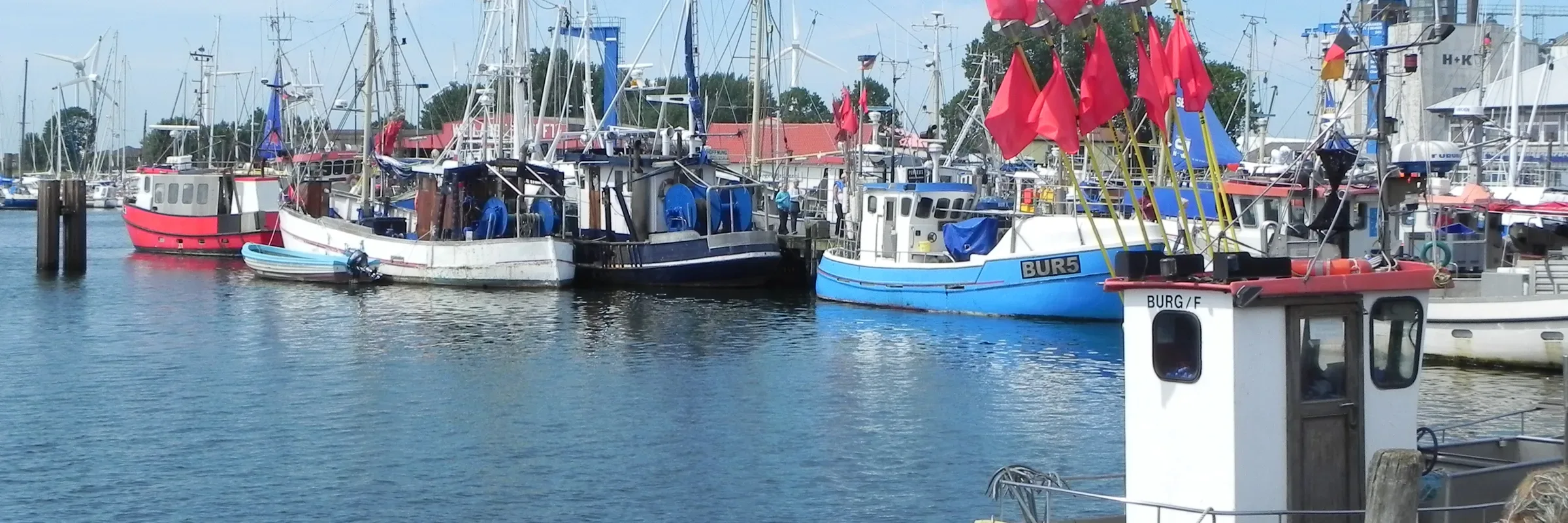
For many people, a fish sandwich at the harbour is simply part and parcel of a holiday on Fehmarn. On the island, you can get them from stalls in the old town of Burg, at snack bars in the harbours and on the beaches, in smokehouses, and from the fishermen at Burgstaaken harbour. The question, therefore, is not so much where to find one, but which ones are worth the trip and what actually goes between the two halves of the roll.
This page therefore also explains where the fish comes from. The answer is more down-to-earth than the usual romanticised image of the harbour, and it helps you make your choice. At the top of the list are the fish rolls that we’ve tried ourselves. For all other establishments, we’ve included what they say about themselves and quoted it verbatim. We checked every establishment mentioned in October 2026 in the Fehmarn Tourist Information Service directory or on its own website. We’ve deliberately omitted prices and opening hours, as these vary from season to season.
We picked up these fish rolls ourselves, and we really enjoyed them. They’re on Breite Straße in Burg, just a few steps from the market, and make a great stop whilst strolling through the old town.
At Grells on Breite Straße, you can get classic fish rolls; according to Fehmarn Magazine, these include matjes, smoked salmon, fried fish and prawns, amongst others. We really enjoyed the rolls there. The stall is right in the heart of the old town and is a great spot for a quick break.
Fisherman’s on Breite Straße serves fish rolls, fish dishes and other hearty meals. We tried the fish rolls ourselves and thought they were really good. According to the directory, your dog is welcome, and when the weather’s nice, you can sit outside.
Fehmarn still has an active fishing industry, centred on the fishing harbour in Burgstaaken. The Fehmarn Fishermen’s Co-operative has been based there since 1949, and according to its own figures, up to nine fishermen set out in their cutters every day. It is not an easy life for them: along the entire Baltic Sea coast of Schleswig-Holstein, the number of fishing boats used as a main source of income fell from 76 to 68 in 2023 alone, according to the state’s annual fisheries report.
These days, it is mainly flatfish that are caught. Of the approximately 871 tonnes of fish landed at the state’s Baltic Sea ports in 2023, almost three-quarters were plaice. Cod and herring together accounted for less than two per cent. This is due to strict fishing regulations: since 2022, no one has been allowed to fish specifically for cod in the western Baltic Sea, and only small boats under twelve metres are permitted to catch herring using set nets and fish traps.
For your fish sandwich, this means that the fish on it often comes from further afield. According to the Fish Information Centre, the herring used for matjes are mainly caught off the Norwegian and Danish coasts and in the North Sea. North Sea shrimps come from the Wadden Sea, and the fish used for ‘Backfisch’ is often Alaska pollock from the North Pacific. The state government assumes that regionally caught fish accounts for only a relatively small proportion of what is on offer in restaurants and shops in Schleswig-Holstein, even though there are no reliable figures to support this.
That’s no reason to go without a fish sandwich. However, if you want to eat fish caught in the Baltic Sea off the coast of the island, your best bet is to buy it directly from the fishermen in Burgstaaken. And everywhere else, it’s worth simply asking where the fish comes from.
It all starts with the smell. Fresh sea fish smells of the sea and seaweed, not fishy. According to the Consumer Advice Centre, the typical fishy smell only develops once the fish starts to go off. If it smells strong at the counter, you’d be better off looking elsewhere.
A good matjes herring is tender and soft, lightly salted and smells of maturation, not of fish oil. Its colour ranges from light grey to reddish-brown; according to the guidelines of the German Food Codex, yellowish patches are considered a defect. Bismarck herring and other marinated herrings should be juicy and firm, but not chewy, and have a tangy flavour.
Smoked fish should be golden-yellow to golden-brown on the surface and have a smoky smell, but not a stale one. Hot-smoked fish such as mackerel or smoked salmon are juicy and firm and do not fall apart. Dark soot marks or a greasy surface are bad signs.
According to the Consumers’ Advice Centre, in the catering sector – which includes fish and chip shops – you’ll usually search in vain for information on the origin of the fish. So just ask. A good fish and chip shop knows where its fish comes from.
The Federal Institute for Risk Assessment advises pregnant women, older people and those with weakened immune systems to avoid smoked fish, marinated fish and pre-cooked prawns unless they have been thoroughly cooked through – even when served on a bread roll. Freshly fried fish, on the other hand, comes straight from the pan whilst still hot.
Burgstaaken is the island’s fishing harbour. It lies about two kilometres south of Burg’s old town as the crow flies; it takes about ten minutes to cycle there. This is where the fishing boats are moored, and where you can buy fish directly from the fishermen who catch it. The harbour is also home to the Submarine Museum, which goes well with a fish sandwich.
In the mornings, the fishermen sell their freshly caught fish directly to visitors at the small jetty in the harbour, according to the tourist information office. According to the co-operative, some customers are already waiting on the quay before the boats have returned, and the fish can also be filleted on request. The catch of the day determines what’s on offer, and anyone wishing to buy fish for their vacation home should plan to visit the harbour early in the day. The current opening hours are available at the The Fehmarn Tourism Service.
The Fehmarnsche Fisch-Lädchen is part of the fishermen’s co-operative and has been located in Burgstaaken harbour since 1993. According to the shop, the fresh fish on offer here comes straight from the co-operative fishermen’s nets. The menu also includes freshly made fish rolls, homemade marinades and fish salads, as well as smoked fish from the shop’s own harbour smokehouse.
Behind the island fishermen are Arne Fröse, who claims to be a sixth-generation fisherman, and Frederik Otten. The company operates three of its own cutters, including the *Tümmler* from 1983, which, according to the company, is the last all-wooden cutter built specifically for fishing in the Baltic Sea. During the season, the fish stall in the harbour sells fish rolls and smoked fish; the island fishermen say they smoke eel and salmon in their own oven. They also sell fresh catches directly to customers who have placed advance orders.
Outside Burg, you’ll find fish rolls mainly in the places you’ll be visiting anyway: at the harbours in the west of the island, on the beaches and in the villages in the centre of the island. Some of these stalls are only open during the tourist season. If you’re exploring the island by bike, you’ll find routes for this on our website Cycling on Fehmarn.
The Kap Orth harbour snack bar is situated right by Orth harbour in the west of the island. It serves freshly made fish rolls, fish dishes and classic snack bar fare, and from your table you can look out over the harbour and the water. According to the directory, the snack bar is child-friendly, and dogs are welcome.
Captain Tommy’s sells freshly made fish rolls and other fish specialities at two locations in the west of the island, in Orth and Flügge, both close to the Baltic Sea. Flügge is also home to one of the The island’s lighthouses.
Alberts Ankerplatz is a food van in Westermarkelsdorf, in the north-west of the island. As well as fish rolls, it serves classic snack dishes and small, hearty meals – a simple way to grab a bite to eat whilst out and about in the west of the island.
The Fischbutze is located at the Inselcamp in Meeschendorf, east of the Südstrand and close to the water. Here, you can put together your own fish sandwich, choosing from bread rolls, fish, side dishes and sauce; according to the staff, gluten-free bread rolls are also available. The Fischbutze is only open during the season.
The Fischkiste in Landkirchen specialises entirely in fish. It serves fish rolls, smoked fish, fish dishes, salads and fish platters, much of which is also available to take away.
Smoked fish makes a great evening meal for your vacation home. You can eat hot-smoked mackerel, smoked salmon or eel straight away, without having to cook them at all. For the journey back to your accommodation, you’ll need a cool box in the car; you’ll also find one on our Packing list.
The fishing co-operative’s harbour smokehouse has been operating in Burgstaaken Harbour since 2005. According to the co-operative, it hangs fresh fish in beech wood smoke every day and uses the hot-smoking method to smoke fish such as salmon, eel, herring, mackerel and trout. The smoked fish is sold in the co-operative’s fish shop.
According to the restaurant itself, Aalkate in Lemkenhafen serves freshly smoked fish and homemade marinades. Restored equipment used in eel and fish catching is displayed between the tables, and the view stretches across the Lemkenhafen Wiek to the Fehmarnsundbrücke.
The menus at fish stalls usually feature the same classic dishes. Here you can find out what sets them apart and where the fish used in them generally comes from. The terms used follow the guidelines for fish set out in the German Food Codex, whilst the information on origin is based on data from the Fish Information Centre, the Thünen Institute and the state government of Schleswig-Holstein.
| Variety | What lies behind it |
|---|---|
| Matjes | Herring caught before the spawning season, lightly salted and aged on the bone using its own enzymes, with at least 12 percent fat. It is caught primarily off the coasts of Norway and Denmark and in the North Sea. |
| Nordic-style matjes herring | Herring that is cured in a brine made of sugar, salt, acid, and spices, often with the help of added enzymes. |
| Bismarck Herring | Herring fillet that is cured in vinegar without heat. It has a tangy flavor and is firmer than matjes herring. |
| Young Fish | Fish that has been breaded or battered and fried. There are no specific rules regarding the type of fish used; it is often Alaska pollock from the North Pacific. |
| Shrimp | North Sea shrimp from the Wadden Sea and the German Bight. For cost reasons, they are primarily shelled in Morocco. |
| Smoked salmon and flaked salmon | Sliced smoked salmon is cold-smoked, while Stremellachs is hot-smoked, which makes it firm and juicy. |
| Smoked Mackerel | Hot-smoked. Mackerel are part of the Northeast Atlantic stock; very few are landed along the Baltic Sea coast of Schleswig-Holstein. |
| Smoked Eel | Hot-smoked. According to the International Union for Conservation of Nature, the European eel is classified as critically endangered, and its harvest is therefore strictly regulated. |
If you prefer to dine at a table, you'll find fish on the menu mainly in Burg, at Burgstaaken Harbor, and in Lemkenhafen. More restaurants, sorted by occasion, are listed on our website Restaurants on Fehmarn, which provides an overview of cafés and bars Dining on Fehmarn.
The Golden Anchor is located right in the Burgstaaken harbor, and according to the restaurant, you can see the water from almost every seat. The menu features fish fillets prepared in a variety of ways.
The Lotsenhus in Burgstaaken Harbor serves Northern German cuisine, including fish dishes, fish soup, and Labskaus. They also offer grilled dishes.
Bootsmann Fischhus is located on the market square in Burg and serves classic regional fish dishes and daily specials that change regularly. Meat dishes and vegetarian options are also on the menu.
According to the restaurant itself, the menu at Kolles Fischpfanne in Lemkenhafen features fried Baltic Sea fish, fish soup, and Labskaus. Smaller portions are available for children.
How far you have to walk to get a fish sandwich depends on where you live. The distances listed below are as the crow flies, measured using the coordinates from the tourism service's directory. The actual walking distance is a bit longer.
| Objective | Distance |
|---|---|
| Fisherman’s | about 100 m |
| Grells | about 150 m |
| Bootsmann Fischhus | about 150 m |
| Hafen Burgstaaken | about 2 km |
Expect seasonal hours. Some fish stands at the harbors and beaches are only open from spring through fall, and some close as early as October. You can find the current opening hours for the snack bars and restaurants in the Fehmarn Tourist Information Centre’s restaurant directory.
If you live in Burg, the Old Town’s fish sandwiches are just a short walk from your door, and you can quickly bike to Burgstaaken Harbor. If you live on the west side of the island, the harbors of Orth and Lemkenhafen are nearby. You usually eat a fish sandwich outdoors, which works well for a vacation with your dog. Suitable Vacation homes with dog You'll find it here.
At Inselblume Fehmarn You'll find high-quality vacation homes, bungalows, and vacation apartments in great locations. If you're looking for a place close to the harbor, the Old Town, and the beach, you'll find the perfect option among our Accommodation in prime locations.