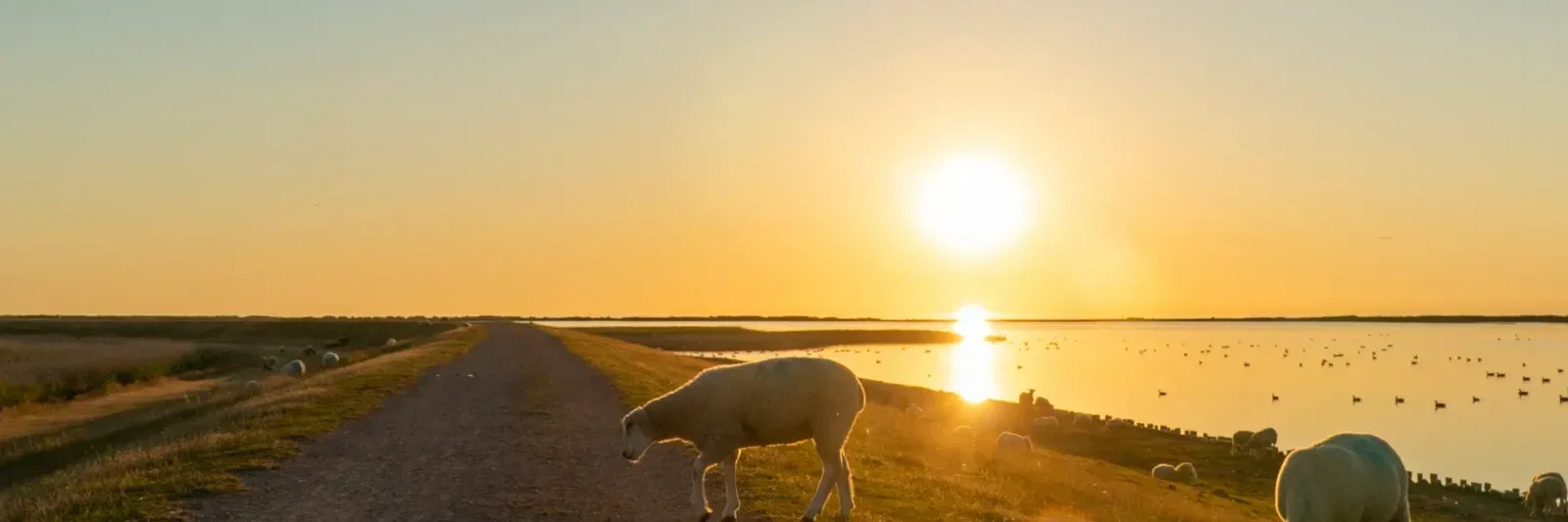
Fehmarn is an island for cyclists, and that’s not just because of the landscape. It’s because there are hardly any hills here. Around 300 kilometres of signposted cycle paths criss-cross the island, many of them along the dyke with views of the water and away from motor traffic.
On this page you’ll find the classic island circuit, all themed routes with distances and maps, tips for cycles with children, and honest advice on the wind. Because on Fehmarn, the wind is the real challenge – not the hills.
The island is flat and easy to navigate. If you get lost, you’re rarely more than a few kilometres from your destination, and the water always serves as a guide. There are signposts throughout, so you won’t need a map app for a day trip.
In recent years, sections of the paths on the dykes have been upgraded and resurfaced. They are now wide enough to allow cyclists to overtake, ride side by side and cycle with a bike trailer without any problems. There are 21 charging points for e-bikes on the island, and nine bike hire companies have bikes available.
The island circuit is the island’s best-known route. It is 78 kilometres long and follows the coastline, taking in natural beaches, inland lakes and cliffs. You can start it anywhere, as it forms a continuous loop.
Fitness-conscious cyclists can complete the circuit in a single day. For everyone else, it’s wiser to split it into two stages or pick out individual sections. The east, with its cliffs, looks quite different from the flat north and west with their extensive dykes, and trying to cover both in a single day means, above all, seeing very little of either.
The island’s five harbours are ideal for taking a break. Along the routes, there are also numerous farm cafés with adjoining farm shops, which are perfect as stops along the way. You can find out where else to stop for a bite to eat on our page about Dining on Fehmarn.
The island circuit on the map
The route is available on komoot. For data protection reasons, we only load the map once you request it. Clicking here will transfer data to komoot.
Would you prefer not to use a card? View the tour directly on komoot.
The Fehmarn Tourist Information Office has put together five themed routes, all between just over 30 and just over 40 kilometres in length. They are signposted, can be started from any point and can be cycled in either direction. For a day out with something to do, they are often a better choice than the long circuit.
| Route | Length | Why it’s worth it | Map |
|---|---|---|---|
| Sundbrücken Tour | ca. 43 km | Leads to the island’s landmark, the Fehmarnsund Bridge | komoot |
| Church tour | ca. 41 km | Connects the old island churches and the villages in the island’s interior | signposted |
| Harbour tour | ca. 40 km | Seaside, with places to stop for refreshments at the harbours | komoot |
| Waterbird Reserve Tour | ca. 35 km | Nature and birdwatching in the west of the island | komoot |
| Grüner Brink Indoor Tour | ca. 31 km | The shortest route, through fields and past the North Beach | signposted |
The Sundbrückentour, at around 43 kilometres, is the longest of the five and takes you to the south of the island. The destination is the Fehmarnsund Bridge, Fehmarn’s landmark, which looks quite different up close than it does from the road. You can find out all about this structure on our page at Fehmarnsund Bridge.
The Church Trail, which is around 41 kilometres long, takes you into the island’s interior and links the old island churches. It’s the perfect choice if you want to get to know Fehmarn away from the coast, as it takes you through fields and small villages that hardly any holidaymakers ever see. We provide an overview on our page about the Churches on Fehmarn.
The Harbour Tour, covering around 40 kilometres, is the maritime route. It links the island’s harbours, and as there is almost always somewhere to stop for refreshments along the way, it is easy to cycle in stages. This is handy for families, as a place to take a break is never far away.
The Waterbird Reserve Tour, which covers around 35 kilometres, takes you to the west of the island. Its main destination is the NABU Wallnau Waterbird Reserve, where you can spot birds from observation huts. Binoculars are the most useful item to bring along here. Find out more on our page about the Wallnau Waterfowl Reserve.
The Grüner Brink Inland Cycle Route is the shortest at around 31 kilometres, making it the ideal place to start. It leads through the centre of the island to the northern beach, where the Grüner Brink – a natural beach with a mix of sand and stones – awaits. Whilst it’s not particularly suitable for swimming with small children, it’s all the more ideal as the destination for a cycle ride.
The Fehmarn Tourist Information Centre has made its routes available on komoot. There you’ll find the route map, the elevation profile and the option to download the tour for offline use. There’s a dedicated collection section for the island: Bike Tours on Fehmarn with komoot.
That isn’t necessary. All the themed routes are signposted throughout the island, and the island is small enough that it’s hard to get lost. However, if you fancy taking a shortcut or extending your route on the spur of the moment, the map will give you a better overview.
In addition to the five themed routes, the Tourist Information Centre offers further signposted routes, including the Pinselpoeten cycle tour and a tour in the footsteps of Kirchner around Wulfen. Ernst Ludwig Kirchner spent several summers on Fehmarn and created part of his body of work here. Find out more on our page about Ernst Ludwig Kirchner on Fehmarn.
If you’re not just cycling on Fehmarn, you’ll come across two national cycle routes here. The Baltic Sea Coast Cycle Route follows the German Baltic Sea coast and passes through Fehmarn on its way. The Mönchsweg runs from Bremen to Puttgarden in the north of the island, ending practically at the ferry terminal for Denmark.
Both are marked on the signposts with their own symbols, so you can recognise them as you go without having to get your map out. For a day out, you can easily pick a section and return via the themed routes, as the paths cross several times.
As there are no hills, cycling trips with children on Fehmarn are much more relaxed than elsewhere. The Grüner Brink inland cycle route, at just over 30 kilometres, is the shortest themed route and can easily be shortened to a half-day trip.
If you’re travelling with young children, it’s best to plan your route along the dyke paths rather than through the villages, and make a farm café your next stop. You can find more ideas for holidays with children on our page at Fehmarn with Kids.
Both options work. Nine bike hire companies on the island have everything you need, from children’s bikes and trailers to e-bikes, with some offering delivery straight to your accommodation. If you’re only planning a few rides, this saves you the hassle of a bike rack and the worry of transporting the bikes on the motorway.
We’ve put together a separate page listing the providers available and what you should bear in mind when booking: Bicycle hire on Fehmarn. During the peak season, it’s worth booking in advance.
On a flat island, an e-bike might seem unnecessary at first. In practice, however, it isn’t, as headwinds here take the place of hills. If you want to cycle the 78 kilometres around the island in a single day, or are travelling with fellow cyclists of varying fitness levels, the motor assistance helps to even out precisely those differences that would otherwise make the ride strenuous.
The infrastructure is in place: there are 21 charging stations spread across the island, and the hire shops have e-bikes available. A fully charged battery is usually enough for a day’s ride, but it’s still worth checking the range before setting off, especially if it’s windy.
There’s almost always a breeze on Fehmarn, and that’s precisely what sets cycling there apart from a tour inland. A route that’s effortless on the way out can become noticeably strenuous on the way back. It’s therefore worth checking the forecast before setting off – it’s more useful than any elevation profile.
In practical terms, this means: plan your route so that you cycle the longer section with a tailwind, and take a windproof jacket with you, even in summer. There’s hardly any shade on the dykes, so sun protection and plenty of water are essential. And because the paths often run alongside open water, it’s rarely a bad idea to wear a hat.
You can cycle on Fehmarn almost all year round, but not every season feels the same. In spring, the paths are quiet and the fields are in bloom; in autumn, the light over the Baltic Sea is at its most beautiful. Both are times when you’ll find yourself cycling alone along the dyke for ages.
In the height of summer, you’ll be sharing the paths with far more people, particularly around Burgtiefe and the south beach. If you’re planning a longer walk, it’s best to set off early in the morning. The themed routes in the island’s interior are quieter than the coastal sections at any time of year anyway.
As the themed routes can be started from anywhere, the location of your accommodation is the main factor determining how quickly you’ll be on your bike in the morning. From Burgtiefe and Burg, both the coastal paths and the island’s interior are right on your doorstep, and the ride back after a day at the beach is short.
At Inselblume Fehmarn You’ll find high-quality holiday flats, holiday homes and bungalows in great locations. Our options are particularly handy for cyclists, as Accommodation in prime locations. And if you’re travelling with your dog, we’ve got something for that too suitable accommodations for you.